Figma Enhanced Dev Mode PRD
Comprehensive product requirements document for enhancing Figma's Dev Mode to bridge the gap between design and development through automated suggestions and improved code snippet accuracy.
5 months
Solo Project with Course Instructor Guidance
Product Manager
2025
The Challenge
Dev Mode needs to bridge the gap between design and development to make design accessible to all. Current pain points include time-consuming design-to-code translation, inaccurate code snippets, and limited designer-developer collaboration tools.
Research & Discovery
Conducted comprehensive market research and user analysis to understand the current state of design-to-development handoff and identify improvement opportunities.
User Research
Interviewed 5 developers to assess Figma's Dev Mode role in their workflow
Key Insights:
- Designers are main customers for Dev Mode adoption
- Developers, project managers, and product managers are secondary users
- Current code suggestions often require additional interpretation
Competitive Analysis
Analyzed similar tools: Zeplin, Penpot, and other design-to-code solutions
Key Insights:
- Third-party tools rely on Figma access
- Limited integration with actual development environments
- Lack of real-time feedback between design and code
Technical Assessment
Evaluated Figma's existing code generation capabilities
Key Insights:
- Current system converts designs to code snippets
- Opportunity to leverage back-end translation system
- Auto-suggestion framework can be built on existing infrastructure
The Solution
Integrating optimization from design to code from the very beginning, as designs are being crafted. Taking inspiration from auto-suggestion features in software to create intelligent design-to-code recommendations.
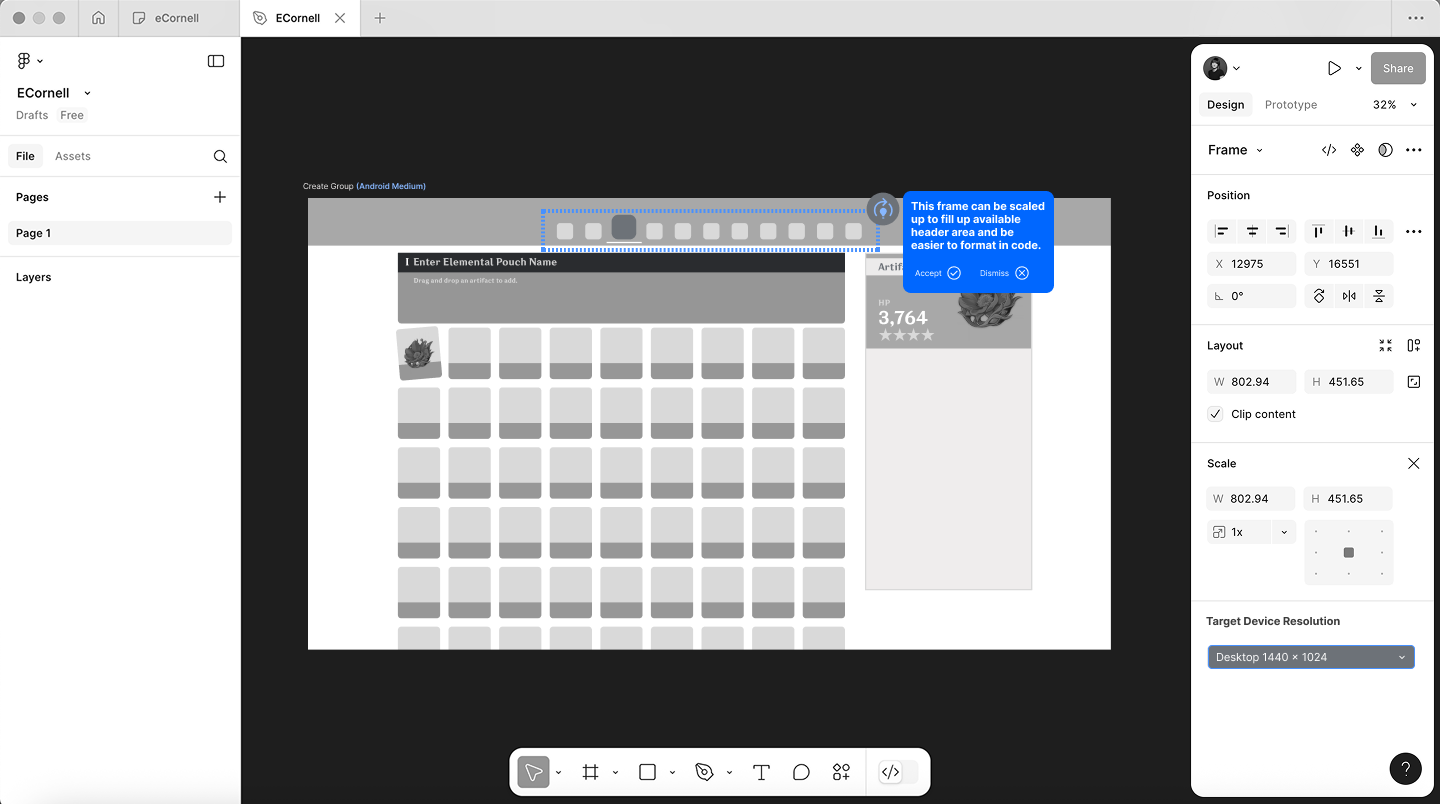
Automated Suggestions for Designers
Real-time assistant that helps designers format their designs in a way that's more consistent with clean, efficient code. Acts like 'autocorrect' for design syntax, improving handoff quality and reducing engineering guesswork.
Enhanced Code Snippet Accuracy
Significantly improve the quality of code snippets developers receive when using Dev Mode. Leverage Figma's existing back-end system to provide more accurate and elegant code suggestions based on actual implementation context.
Designer Champion Program
Grow grassroots momentum by educating designers and fostering community engagement. Create webinars, training sessions, and forums to inspire designers to become vocal brand advocates for Dev Mode adoption.
Product Development Process
Market Research & Problem Definition
Activities
- User research
- Competitive analysis
- Problem prioritization
Deliverables
- User personas
- Problem statement
- Success metrics
Solution Ideation & Risk Assessment
Activities
- Solution brainstorming
- Risk matrix creation
- Technical feasibility
Deliverables
- Solution concepts
- Risk assessment
- Technical requirements
PRD Development & Stakeholder Alignment
Activities
- Requirements documentation
- Engineering effort estimation
- Go-to-market planning
Deliverables
- Complete PRD
- Engineering specs
- Launch timeline
Metrics Framework & Success Planning
Activities
- KPI definition
- Testing strategy
- Rollout planning
Deliverables
- Metrics dashboard
- Testing plan
- Success criteria
OKRs
Comprehensive PRD with detailed success metrics and engineering effort estimation, demonstrating strategic product thinking and stakeholder alignment.
Risk Assessment Matrix
| Likelihood | Low | Medium | High | Mitigations |
|---|---|---|---|---|
| Low | Misfiring suggestions on edge cases | Suggestion feels redundant | Designers ignore suggestions | Launch with feedback mechanism, tune suggestions with A/B testing, offer context |
| Medium | Mild performance lag | Misaligned with design intent | Creates significant technical debt | Modular system architecture, rigorous QA, phased rollout |
| High | Minor UI bugs | Suggestions introduce subtle design drift | Breaches trust due to bad suggestion history | Add "undo" support, suggestion logs and version history, option of previewing |
Engineering Effort Distribution
Success Metrics Framework
| Objective | Key Result | Target |
|---|---|---|
| Auto-suggestions for designers | Adoption among active designers | 20% |
| Suggestion acceptance rate in non-optimized files | 30% in 50% of files | |
| In-app satisfaction rating | 4/5 | |
| Designer feedback submissions | 100+ | |
| Improve code snippets for devs | Developer feedback collected | 75+ |
| Positive ratings on snippet relevance/usability | 75% | |
| Code Connect trainings/webinars | 4 sessions, 50+ attendees each | |
| Code Connect usage increase | 20% | |
| Designer champions for Dev Mode | Webinars hosted for designers | 4 sessions, 100+ attendees each |
| Community/forum engagement increase | 40% | |
| Dev Mode signups via referrals | 30% |
"You're asking the right questions, seeing both the forest and the trees, and designing with both users and systems in mind."
Key Learnings
Product success depends on understanding both user psychology and technical constraints
Designer adoption drives developer engagement - focus on the primary user first
Risk assessment and mitigation strategies are crucial for complex feature development
Grassroots community building can be more effective than top-down feature rollouts
Next Steps
Build MVP prototype for auto-suggestion engine
Conduct user testing with target designer personas
Create comprehensive onboarding flow for new Dev Mode users